I like to go barefoot whenever possible, but lately I've been wearing my high boots everywhere. With the warm spell in March, rattlesnakes have emerged from dormancy early, and we've seen a rash of snakebite stories in the news. In a typical year, there are 250-800 rattlesnake bites in California, resulting in 1-2 deaths. Two high-profile rattlesnake bite deaths have already been recorded this year. Seems like a good time to take a closer look at our venomous neighbors.
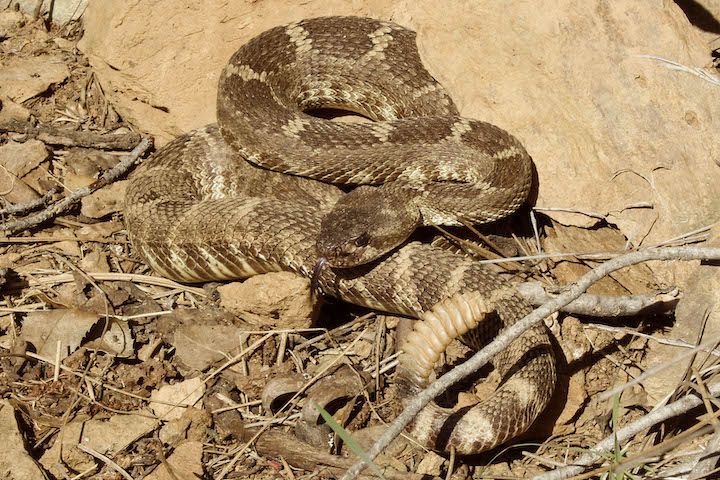
The Northern Pacific Rattlesnake (Crotalus oreganus) is the only venomous snake native to Monterey County. Rattlesnakes are "pit vipers", denoting the heat-sensing organs above the mouth used for hunting prey. They are oviparous, bearing live young. Rather than hibernating, they undergo brumation, a process in which the metabolism slows down significantly. Even in winter, they may emerge on a warm day to bask.
Since earliest times, snakes have inspired fear in humans, some justifiable, some not. Stories of rattlesnakes chasing people appear in popular legend. Although they can strike one-third or more of their body length, rattlesnakes are afraid of people and will only strike defensively if threatened.
Another common myth is that baby rattlesnakes are more dangerous than adults because they can't control their venom output. The truth is, babies can indeed control their venom. Adults are more dangerous because of their size. It's interesting to note that as many as 25% of bites are dry, meaning no venom is injected.
We always expect rattlesnakes to play fair and rattle before striking. This is often not the case. They rely heavily on camouflage and prefer to stay hidden rather than announce their presence by rattling.
Can you tell a snake's age by the number of rattles? Not really. Rattles are discarded and regrown every time the snake sheds. Depending on conditions, rattlesnakes can shed several times a year, gaining new segments with each molt. However, if all the segments are wide without tapering, you're looking at a mature specimen. Tapering rattles indicate the individual is still growing.
According to herpetologist Greg Pauly, if bitten, "you are 6 times more likely to die from a lightning strike or a dog attack, 8 times more likely to die from a TV set or other large furniture falling on you, 14 times more likely to die falling out of a tree, and 95 times more likely to die falling off a ladder."
I'm still going to keep wearing my boots. That, and refrain from climbing trees and ladders


Comments